The Great NYC Conversion Bet: Can Empty Offices Really Fix the Housing Crisis?
Walk through the Financial District today and you can feel the shift happening in real time. Office workers still stream through the streets during the week, but look up and you will see scaffolding, new window lines, and leasing banners where corporate logos used to hang. Buildings that once emptied out at 6 p.m. are being rebuilt for something entirely different: full-time living.
 |
| 25 Water Street |
At properties like 25 Water Street, crews are transforming more than a million square feet of former office space into apartments. A few blocks away at 111 Wall Street, another massive conversion is underway, backed by record-setting financing. And at 80 Broad Street, a smaller but highly watched project is moving forward under a new tax incentive that has quickly become the centerpiece of New York’s housing strategy.
These projects are not isolated. They are the visible edge of what may be the most important real estate story in New York right now.
The Simple Idea Everyone Clicks On
The reason this topic dominates headlines is straightforward: it feels like a solution hiding in plain sight.
New York City has a severe housing shortage. The city needs more than 500,000 additional homes to meet demand, while rental vacancy hovers around 1.4 percent, one of the lowest levels in decades. At the same time, the office market is struggling with vacancy rates above 22 percent, and building values have dropped dramatically since 2019.
Put those two facts together and the conclusion seems obvious. Too many empty offices. Not enough apartments. Convert one into the other.
That logic is intuitive, visual, and emotionally satisfying. It is also why stories about office-to-residential conversions consistently rank among the most-read pieces across real estate media, from trade publications to consumer-facing outlets.
But the reality is more complicated than the headline.
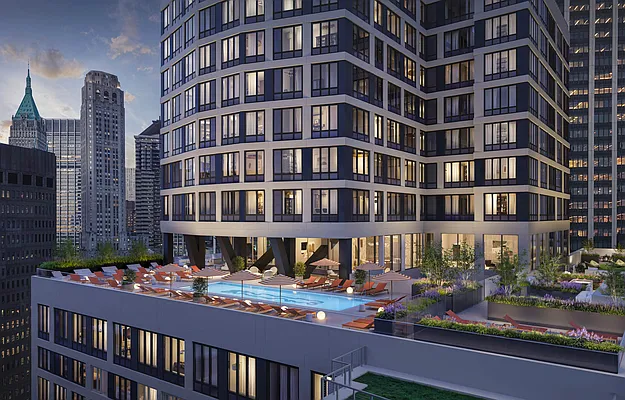 |
| Rendering of vertical expansion and roof-terrace atop 25 Water Street |
The Numbers Behind the Conversion Boom
There is real momentum behind this trend. As of early 2025, New York has roughly 40 to 45 office-to-residential conversion projects in the pipeline, totaling more than 15 million square feet and expected to produce around 17,000 to 18,000 new apartments.
That is not theoretical. It is already happening.
25 Water Street is on track to deliver roughly 1,300 units, making it the largest office-to-residential conversion in the country.
111 Wall Street is expected to create over 1,500 apartments and secured one of the largest conversion loans ever issued in the U.S.
80 Broad Street will add more than 300 units and has become a case study for how the latest tax incentives actually work.
Zoom out, and the scale becomes even more striking. One estimate suggests that just a few dozen eligible buildings could eventually produce nearly 20,000 apartments under current programs.
And yet, even at that scale, conversions are only scratching the surface of the city’s housing gap.
The Policy Engine: 467-m and “City of Yes”
This wave of conversions is not happening by accident. It is being driven by a combination of new tax incentives and zoning changes that finally make these projects financially viable.
The most important piece is a program known as 467-m, a property tax incentive designed specifically for office-to-residential conversions. In simple terms, it offers developers up to 35 years of tax relief if they agree to include income-restricted housing, typically around 25 percent of the total units.
Without that kind of tax break, most conversions simply would not pencil out. Office buildings were not designed to be apartments. Reconfiguring floor plates, adding plumbing, cutting new windows, and meeting residential code requirements is expensive and technically challenging.
Alongside 467-m is the broader City of Yes zoning overhaul, which opens up far more buildings to potential conversion by loosening outdated restrictions. Combined with programs like the Office Conversion Accelerator, the city is effectively trying to remove as many barriers as possible.
The result is a rare alignment between public policy and private market incentives. Developers need viable projects. The city needs housing. Conversions sit at that intersection.
Why Financial District Is the Epicenter
If you want to see the future of this trend, look at Lower Manhattan.
The Financial District has been gradually transforming into a mixed-use, 24/7 neighborhood for years, but the current wave of conversions is accelerating that shift dramatically. Buildings that once housed back-office operations or outdated financial firms are being reborn as residential towers with amenities, retail, and new street life.
This is not just about adding apartments. It is about reshaping entire neighborhoods.
Remote work and changing commuting patterns have only reinforced the trend. Many companies are consolidating into newer, higher-quality office buildings in Midtown or Hudson Yards, leaving behind older stock that is increasingly difficult to lease. Those older buildings are precisely the ones now being targeted for conversion.
In other words, the geography of work is being rewritten at the same time as the geography of housing.
The Catch: Conversions Are Not a Silver Bullet
For all the excitement, there is a hard truth at the center of this story.
Even if every currently planned conversion is completed, the total output, roughly 17,000 to 20,000 units, is a fraction of what the city actually needs. Against a housing shortfall of more than 500,000 units, it is meaningful but nowhere near sufficient.
There are also important limitations on what conversions produce.
Most office buildings are best suited for smaller apartments due to their layout, which means the majority of new units are studios and one-bedrooms. That is helpful for certain renters, but it does little for families looking for larger, more affordable housing options.
And while the 25 percent affordability requirement under 467-m is significant, it still leaves the majority of units priced at market rates in some of the most expensive neighborhoods in the city.
Meanwhile, another part of the housing market is under stress. Owners of older rent-stabilized buildings are facing rising insurance costs, higher operating expenses, and regulatory constraints that make reinvestment difficult. That side of the market does not get the same headlines, but it plays a major role in overall housing supply.
Conversions vs. Ground-Up Development
One of the most important, and often overlooked, questions is how conversions compare to building new housing from the ground up.
Conversions are appealing because they reuse existing structures and can sometimes move faster than new construction. But they are inherently limited by the buildings they start with.
Ground-up development, on the other hand, has the potential to deliver larger volumes of housing, more diverse unit types, and purpose-built residential layouts. The problem is that it depends heavily on zoning approvals, financing conditions, and tax incentives that have been inconsistent in recent years.
In a perfect world, the city would be doing both at scale. In reality, conversions have become the more politically and financially feasible option in the current moment.
The Bigger Picture
The surge in office-to-residential conversions is one of the clearest examples of New York adapting to a post-pandemic reality. It reflects changes in how people work, where companies locate, and what the city needs most urgently.
It is also a reminder that no single policy or trend will solve a housing crisis of this magnitude.
Conversions will add thousands of apartments, revive underused buildings, and help reshape neighborhoods like the Financial District. They are a meaningful piece of the puzzle and, in many cases, a smart reuse of obsolete space.
But they are not a cure-all. The math simply does not support that conclusion.
The real story is not that empty offices will save New York’s housing market. It is that the city is finally starting to use every tool available, zoning changes, tax incentives, adaptive reuse, to chip away at a problem that has been decades in the making.
And for now, that is enough to keep cranes in the air, scaffolding on the sidewalks, and readers clicking on every new conversion headline that promises a glimpse of what New York might look like next.


